Larson, E. (October 15, 2014). Raise a
thick-skinned kid. Parents, 88(10), p. 72-79.
The article “Raise a thick-skinned
kid” in the October issue of Parents
was a very silly and a no brainer when it came to the advice given in the
story. The story began with the author, Elizabeth Larsen’s, son crumbled under
any type of pressure he received by ANY of his coaches. The author and her
husband were the complete opposite when it came to pressure as a small child,
learn to use it as an advantage and grow from it. The article brought in many
professional opinions about how children today having no coping skills and how
they need to learn how to put their emotions into place, recover from the
situation, and thrive from it. The article then gives examples on how other
parents build their children’s thick skin with sharing “survival” stories from
the parents past, standing up for what they believe not matter what, or not
sugarcoating the tough stuff. The information proved by the story is something
parents should know from when they were children. Children, in my opinion,
today are too coddled by their parents and then parents don’t know what to do
so they turn to getting advice from a parent centered magazine. Parents should
take the information of having to deal with pressure and confrontation from the
past and use it to help shape their children’s lives.
The reason when I choose this
article in this magazine out of all the other magazines in the world and
articles in the world would be because of convenience and curiosity. Parents is geared for an audience with
children who are either newborn, toddlers, or children or those who are
expecting children. While my mother is a parent, she isn’t going to start using
these tips on her two twenty plus grown adult children. No one in my house has a
child or wants one at the current moment so we are always scratching our heads
when we get our issue of Parents in
the mail. The magazine has no name on it nor an address. It is just a magazine
that shows up at my house every month. While looking for an article to find, I
came across the “raise a thick-skinned kid” story and it raised my curiosity. I
have always felt like in today’s day and age, society likes to give children
everything they want. While I don’t have a child myself, I’ve seen countless
statuses and pictures of friends on Facebook spoiling their less then one year
old on Christmas.Parents should learn
to not coddled their children as much because they are just building a wall up
for some other person to knock it down and the child has no where to go to
“protect” themselves. Having read the story, I was curious to see what ads
surrounded the piece.
There were 90 ads within the entire magazine.
The Parents magazine had a totally of 176
pages which mean that there was a total of 51% of pages dedicated to ads. I
think this is way too many ads for the magazine. The ads would break up the
stories breaking my reading to advertise Gymboree. I feel like the magazine
cares more about selling you on what is in their ads instead of giving good
information to read. The ads do fit the magazine with ads for parent’s such as
birth control and cleaning supplies and for their children which are food like
Campbells’ and Lunchables and car seats. I feel like the ads that were places
in the article I read were placed there for a reason. The first ad was for
Gymboree basically saying, “Hey, make sure you kid looks good.” The next ad was
for Minted, which could say “Make your house the cool house to hang out at.”
The last ad is for Strayer University with the quote saying, “Your success is
your family’s success”. The ad were put in the article to make sure while making
your child has good esteem you need to make sure that they can be proud and
like you.
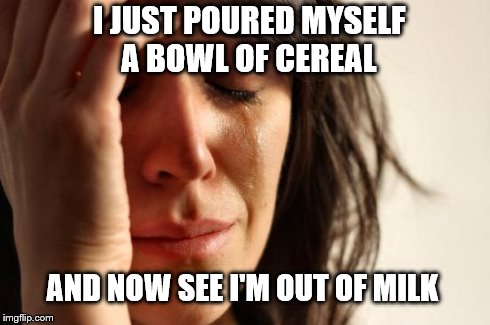
Ever have that type of day
were nothing was going your way? Like pouring yourself a bowl of cereal and
seeing you are out of milk or when you put on your winter jacket and your
sweater sleeves get bunched up? How did those types of events make you feel? Angry?
Annoyed? Upset? What if I told you, you were having a First World Problem.
First World Problems are frustrations and complaints that are only experienced
by individuals who are more privileged normally living wealthy countries. First
World Problems are usually used as a tongue in cheek comedic device to make
light of trivial inconveniences.
I have always liked this meme for its tongue in cheek
humor since I, like most people, have had problems like when we were discussing
this blog assignment and I was writing notes about it, I realized something. My
brand new watch I got for Christmas seemed to be getting a little dirty due to
the light color of the leather wristband. I looked my wrist and sighed thinking
I would now have to look up a way to clean my watch after class. Then it clicked;
I was having a First World Problem.
The first known case of a First World Problem would be
from the Canadian alternative rock band named Matthew Good Band. The band came
out with a song called “Omissions of the Omen” from their 1995 album Last of the Ghetto Astronauts. The
lyrics of the song are “And somewhere around the world / Someone would love to
have my first world problems” The song showcases how the First World Problem is
something that someone who doesn’t live in a first world would rather have the
problems you face everyday then the ones they have. The problems they face
would be far more severe such as poverty or famine. Ten years later in 2005,
Urban Dictionary added the term First World Problem into their database.
The spread of the First World Problem meme start in 2008
on Tumblr. The Tumblr is call http://therealfirstworldproblems.tumblr.com/ and is still running today. One year later,
the hashtag #firstworldproblems emerged on Twitter and from there the meme
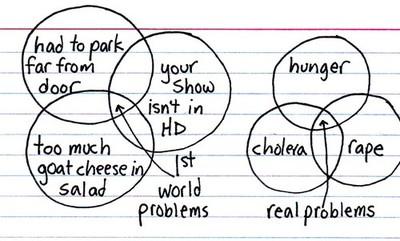
became what it is today. In 2010, blogger Jessica Hagy posted a venn diagram
representation of “First World Problems” vs. “Real Problems”. In 2011, American stand-up comic Louis C.K.
released his third comedy album titled “Hilarious,” which featured a skit about
the extreme gap between the grievances of first world citizens living in over
developed societies which he labeled “white people problems,” and the
day-to-day struggles experienced by people living in countries that are
considered to be of the Third World. In that same year, a subreddit was created
named /r/firstworldproblems. When the subreddit was created, the image of the
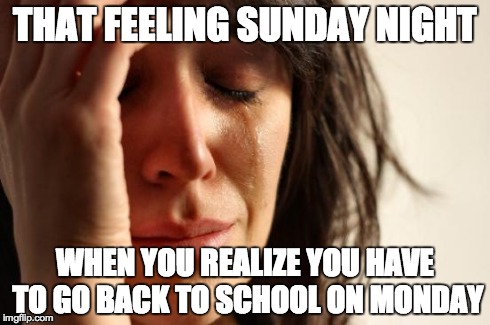
woman with her hand on her face crying emerged as the face of the meme.
The First World Problems meme resonates differently with
different audiences. As Americans, we see it as something humorous and
relatable. Other countries, especially those less fortunate, will see the meme
as a silly and stupid thing people should care about. They should care about
real problems in the world like Ebola or human trafficking. Some people would state how people should "shut up" about their First World Problems. The audience this
meme would work best for is an American audience. It would be catering to an
audience who has all these things that happen to them such as if two of your
favorite TV shows were on at the same time and you can’t decide which one to
watch.
The meme has several spin-offs such as the Third World
Success, White Girl Problems, First World Problems Cat, Over Educated Problems,
First World Metal Problem, 1990s First World Problems, First World Stoner
Problems, and 1890s Problems. The First World Problems is a whimsical meme that
allows people of wealthier countries to joke about their daily struggles, which
may not be as important to the real world problems but are big at the moment
for that person.
While reading the Keystone Newspaper, the student-run campus
newspaper, I found a news article that peeked not only my interest but also my
emotions as well. The emotion I mainly felt was anger. The article came from
page 2 of the first issue of the Spring 2015 semester and it is called “Laundry
prices increase 50 cents since last year”. The article talked about the cost
increase for laundry services on campus due to new technology coming to campus
“soon”.
This is probably the most accurate description
of how I felt after reading the article
The article
began with the concerns of students who were unhappy about the changes in some
way or another. The students equally wanted answers to the price increase of
the laundry facilities around campus. The main reason is to improve KU’s
laundry operations by adding Bear Bucks card readers and getting new high
efficiency washers and dryers in residence halls. The article ended with a
statement saying a new laundry technology initiative will be coming “soon”.
My reaction when the machine becomes unbalanced!
The news
article was extremely bias because it was geared to making sure the university
looks like it is making “changes” instead of just jacking up prices to make
changes in the future. Although, I don’t live too far from campus that I could
bring my dirty laundry home to wash, it is just more convenient to wash here on
campus instead of lugging it home then back to campus. EVERYTIME, I do wash here it is like an endless battle with
machines especially with the washers. The washers have a lip in them and no
matter hard I make sure it doesn’t happen, my socks will get stuck in
those devilish lips. This causes the machine to get unbalanced and not wash my
clothing properly. Thus, leaving me with unwashed or soaking wet clothing. I am
not the only one who has this problem, many of times I’ve gone to get my
laundry and I see the person next to me in distress due to the easily unbalanced
washing machines.
I truly
believe in the quote “Actions speak louder than words” and the university
should have done that. The washers and dryers should have been replaced with
the price increase instead of a price increase with the “idea” of new washers
and dryers in the future. Students, myself including, would rather see newer
machines than the old machines with increased prices.
I am Kimberly Koehler and a senior
on her last semester at Kutztown University. My major is Communication Studies
with a minor in Public Relations. I am the president of Communication Club,
secretary and head of events for Public Relations club, as well as a member of
Lambda Pi Eta so I am very passionate about my major and minor. My short-term
goal is to have as much fun as possible in my final semester at KU and my
long-term goal is to find a job in Public Relations doing what I love. While I
don’t mind where my first PR job is, I would love to do PR for Disney or a
sports organization preferably a baseball one. My hobbies are anything and
everything Disney, baseball, fashion, exercise, music, and puppies. There are
exactly 15 days until spring training and I couldn’t be more excited! Here is
an accurate description of my love for dogs (as seen above). I am excited to learn about mass
communication this semester since it is something we are exposed to everyday.
Reflections on
Professor’s Blog:
I agree with the blog post done by
my professor because I truly believe in the quote “Nothing is constant except,
of course, change” by Heraclitus. The way we receive information has changed from
the time I was in high school as a senior to right now as a college senior,
which is only four years. While we live in the world dictated by social media
and what we post of social media, we can’t dispel it because there is a lot of
important information within the meaningless posts. Social media whether people
like or not is the future. It is very helpful to learn information and pass
information very quickly. Anyone who tries deny social media will be surround
it whether it be the use of hashtags on a commercial or a company having a
giveaway contest on one of their many social media sites. While social media
has many pros, it also has many cons such as people taking things way to
literally when in real life people would understand the sarcasm to the comment
made.
For the longest time, if companies were advertising a
product or service they would show a happy heterosexual, racially similar
family with two kids in their ads. This became on the norm for what
advertisements would be. Every advertisement was the same until companies began
to notice this is wasn’t what the normal American family was anymore. Families
just like people come in all shapes and sizes. A family can have two moms or two
dads, a blended family, a family with only one parent, or an interracial
family. Honeymaid, the graham cracker company, had a persuasive campaign to try
to fix what we call a “normal” family.
Launched
earlier this year, the “This is wholesome” campaign showcased a whole array of
families. It shows consumers how much the American family has changed. The ad
showcases a two-dad family, a rocker family, a single dad, an
interracial family, and a military family. These families would be considered
broken but with Honeymaid’s #NotBroken campaign these families are shown like
they are everyday people.
Honeymaid
knew that their ad would cause some controversy and it did as soon as it
premiered. Social media was all in frenzy with supporters and haters just like
with anything that causes main issues to be questioned. The main idea of the
campaign some consumers were opposed to was the two-dad family.Honeymaid responded to this by creating
another ad taking all the information tweeted at them and making something out
of it. The ad has two artists taking all the hateful comments to the ad
campaign, which were but not limited to “This is disgusting!”, “Totally not
wholesome”, and “I Do Not Approve” and made art with them. The artists rolled
up the hateful comments, glued them together, and made the word love. The
artists then took positive comments, which contained statements like “This
makes me heart happy”, “I love what Honeymaid has done here”, and “This is
beautiful” and filled in the rest of their art with them. The artists did the
same process as they did with the hateful comments and they just filled in and
outlined the word love with all the positive comments.
Honeymaid
wanted to sent forth the idea that family is first in their ad campaign. They
also wanted the public to know that they are a family brand. It doesn’t matter
what type of family you have, it’s how happy you are within that family unit.
The “this is wholesome” persuasive ad campaign has two meaning behind it. On
one hand, it is actually describing the product. Their graham crackers are made
with 100% whole grain.On the other
hand, the hand is talking about how the families featured in the ad are
wholesome. Honeymaid showcases how just because your family isn’t what “normal”
is, doesn’t mean that your family isn’t just as good or even better then what
the “normal” family is.
This
topic would work well with Robert Mapplethorpe’s work. Mapplethorpe was a trailblazer
in exploring homosexual themes. Honeymaid’s ad called “Dad & Papa” explores
a two-dad family as just an everyday family. The family does everything a
“normal”, “traditional” family does. The ad shows the two-dads talking about
being excited to be parents and taking care of their children.